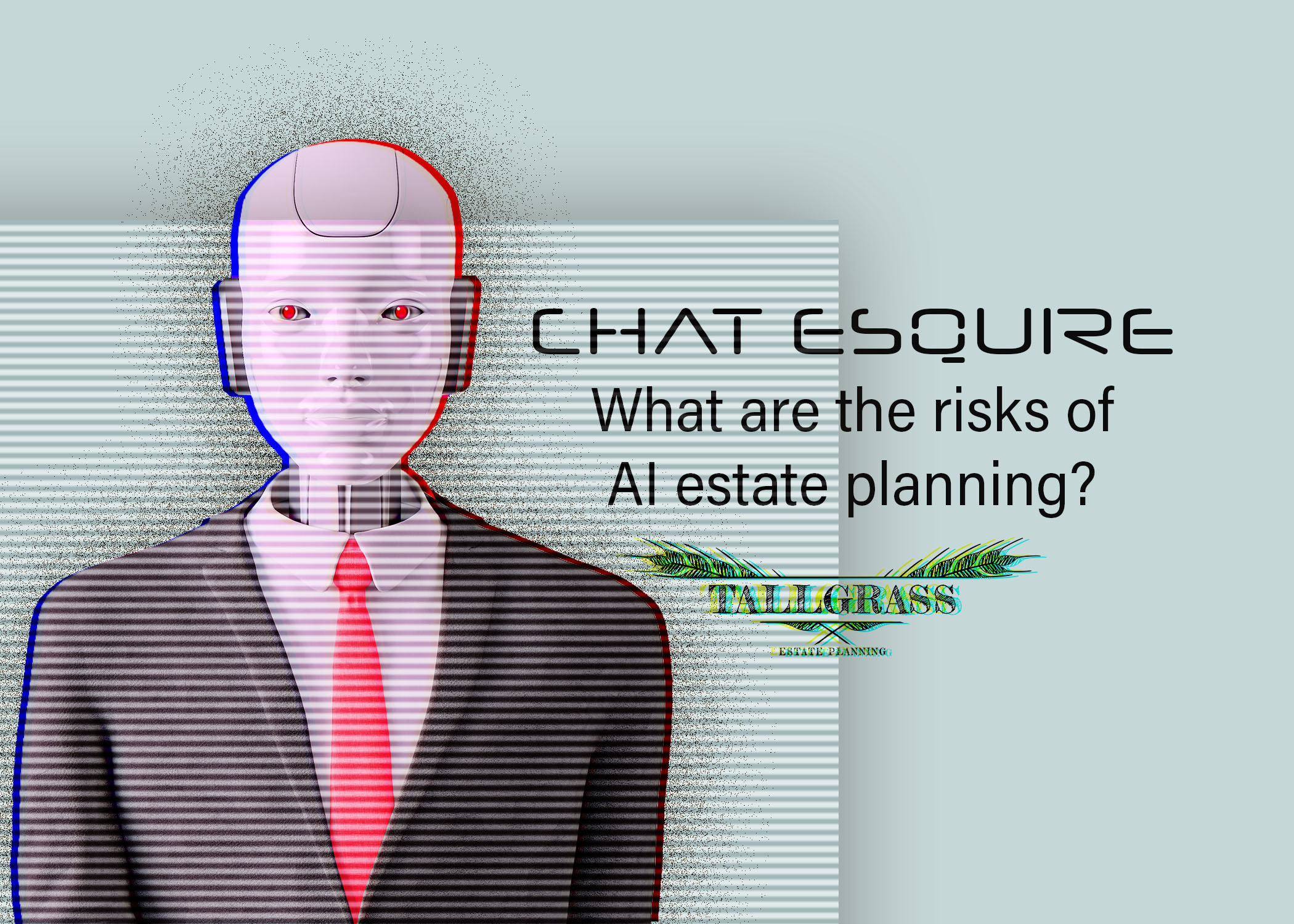
AI is everywhere now. Love it or hate it, there’s no denying it’s a powerful tool. And for some, it’s tempting to rely on AI for everything from web design to personal therapy to planning family vacations and even drafting legal documents.
Relying on AI to draft estate planning documents presents substantial legal and practical risks, particularly under Oklahoma law, where validity often depends not merely on the text of the instrument but also on precise statutory compliance, proper execution, coordination among documents, and fact-specific strategies.
The main concerns include invalid execution, failure to account for Oklahoma law, ambiguity or internal inconsistency, inadequate incapacity planning, lack of coordination with non-probate transfers, omission of contingencies, tax and benefit-planning errors, privacy concerns, and the absence of accountable professional judgment.
Key Legal and Practical Risks
1. Failure to Satisfy Oklahoma Formalities
A will may be ineffective if it does not comply with Oklahoma execution requirements. AI-generated documents are often based on generalized templates and may not accurately reflect Oklahoma statutory formalities regarding signature, witnesses, and related probate requirements.
This is a critical distinction. A document can appear professionally drafted yet still fail in probate if execution formalities were not followed exactly. AI may generate a text that looks plausible but does not ensure that the signing ceremony, witness qualifications, attestation, or any self-proving components are handled correctly, causing the will to fail.
Practical consequence: A purported will may be denied probate in whole or in part, causing property to pass under intestacy statutes or under prior instruments.
2. Inadequate Customization to Family Structure and Intent
Estate planning is highly dependent on the unique relationships, assets, values, and other facts specific to certain clients. AI tools generally respond only to the information affirmatively provided, and they do not reliably identify unstated but legally significant facts. This is especially problematic in matters involving:
- blended families;
- estranged children or intentional disinheritance;
- minor beneficiaries;
- disabled beneficiaries;
- beneficiaries with creditor, divorce, or substance-abuse concerns;
- subsequent marriages;
- business ownership;
- out-of-state real property; or
- unequal lifetime gifts among children.
AI can draft language, but it does not exercise legal judgment in determining whether a simple will, revocable trust, marital planning, special needs trust, disclaimer planning, or beneficiary-controlled distribution structure is actually appropriate.
Practical consequence: The instrument may not implement your actual objectives and may instead create litigation risk among heirs and fiduciaries.
3. Ambiguity, Contradictions, and Drafting Errors
AI-generated documents may contain vague phrases, inconsistent terminology, undefined terms, or contradictory provisions across multiple documents. Common examples include:
- referring to “my children” without clarifying whether that includes future children, stepchildren, adopted children, children from prior relationships, or assisted reproductive technology, such as frozen embryos or gametes;
- gifting “the house” when multiple residences or real properties or exist or if properties change over time;
- using inconsistent descriptions of beneficiaries or assets;
- failing to specify contingencies if a beneficiary predeceases; and
- creating conflicts between a will, trust, transfer-on-death designations, and beneficiary forms.
Such ambiguity may force judicial construction proceedings or fiduciary disputes.
Practical consequence: Increased probate expenses, delays, and intra-family litigation.
4. AI Does Not Reliably Coordinate the Entire Estate Plan
An estate plan is not just a will. It usually includes some combination of:
- durable financial powers of attorney;
- advance directives/health care planning documents;
- guardianship nominations;
- deeds or transfer-on-death deeds;
- beneficiary designations for retirement plans and life insurance; and
- business succession documents.
AI may produce one document in isolation without ensuring that all related instruments are consistent. For example, a will cannot override many beneficiary designations or jointly held asset survivorship arrangements. If the AI-generated will says one thing and the account paperwork says another, the non-probate transfer often controls.
Practical consequence: Assets may pass outside the will in a manner contrary to the client’s intent.
5. Deficient Incapacity Planning
Many estate planning failures arise before death, not after it. AI-drafted packages may not properly address or misstate powers needed during incapacity, including authority over:
- banking and investment management;
- real estate transactions;
- tax matters;
- digital assets;
- business operations;
- gifting;
- trust funding; and
- long-term care or public benefits planning.
A power of attorney that is too narrow, does not properly define incapacity, is improperly executed, or is not accepted in practice can force family members into guardianship proceedings.
Practical consequence: Avoidable court involvement, delay in asset management, and increased expense during incapacity.
6. Public Benefits and Special Needs Errors
Where a beneficiary receives or may later need means-tested benefits, outright distributions can be disastrous. AI may not identify the need for a special needs trust or other protective structure. Similarly, Medicaid and longterm care planning are highly technical and state-specific.
Leaving assets directly to a disabled child or beneficiary can jeopardize eligibility for SSI, Medicaid, or other critical means-tested benefits.
Practical consequence: Loss of public benefits or forced spend-down that could have been avoided with proper drafting.
7. Tax Planning Mistakes
Even where federal estate tax is not presently an issue, tax planning remains relevant. AI may fail to evaluate or properly draft for:
- basis step-up considerations;
- income tax consequences of trust structure;
- retirement account distribution planning;
- generation-skipping transfer issues;
- charitable gifting structure;
- marital and portability-related planning; and
- business or highly appreciated asset planning.
Some commentary in recent legal and estate planning sources notes that AI-generated trust provisions have included clauses that could inadvertently waste tax advantages or mishandle exemption planning.
Practical consequence: Unnecessary tax burden, inefficient administration, or frustrated wealth-transfer goals.
8. Failure to Address Contingencies
A competent estate plan must anticipate changed circumstances, including:
- a beneficiary predeceasing the client;
- simultaneous death;
- divorce or remarriage;
- fiduciary incapacity or refusal to serve;
- sale of specifically devised property;
- after-born or omitted descendants; and
- changed asset composition over time.
AI frequently generates a baseline document but omits robust backup provisions. Estate planning documents that do not address contingencies are often the ones that fail when real life intervenes.
Practical consequence: Partial intestacy, lapsed devises, fiduciary disputes, and court intervention.
9. Improper Reliance on Incorrect or Outdated Law
AI systems can produce results that sound authoritative but are ultimately incorrect. They may rely on outdated legal rules, generalized multistate templates, or even fabricated authorities. In estate planning, where state law varies materially and changes over time, this is particularly dangerous.
Because the user often lacks independent knowledge to verify the output, AI can create a false sense of confidence around a flawed document.
Practical consequence: The plan may be invalid, incomplete, or based on legal assumptions that do not apply in Oklahoma.
10. No Legal Judgment, No Professional Accountability
Estate planning is not a clerical exercise. It involves legal counseling, issue spotting, strategic choices among competing structures, and assessment of risks regarding family dynamics and potential litigation. AI does not interview the client in the manner necessary to identify hesitation, conflict, incapacity concerns, undue influence, or practical administration issues.
It also does not assume professional responsibility for the resulting plan. If a clause is poorly chosen, if the structure is unsuitable, or if the documents are not coordinated, AI is not functioning as a fiduciary, scrivener with professional duties, or accountable legal advisor.
Practical consequence: No meaningful quality control at the point where nuanced legal judgment matters most.
11. Privacy and Confidentiality Risks
Estate planning requires disclosure of highly sensitive information, including family relationships, financial accounts, asset values, health concerns, business interests, and dispositive intentions. Uploading this information into consumer AI platforms may expose it to data retention, third-party access, or model training under platform terms.
Recent legal commentary has also highlighted a developing privilege risk where information shared with certain AI tools may not be treated as confidential in the same manner as communications with counsel.
That is, there is no attorney-client privilege with your AI program.
Practical consequence: Potential loss of confidentiality, data exposure, and in some contexts possible privilege complications.
12. Increased Probate and Litigation Risk
The cumulative effect of these deficiencies is straightforward. AI-generated estate planning documents may shift cost and uncertainty from the drafting stage to the administration stage. That usually means:
- more probate litigation;
- greater expense for personal representatives and trustees;
- family conflict over interpretation;
- delay in distributions; and
- increased likelihood that a court, rather than the decedent, determines the outcome.
This is especially acute where the document attempts to handle disinheritance, unequal treatment of descendants, business succession, special-needs planning, or trust-based planning.
Application in Oklahoma
In Oklahoma, these concerns are magnified by the importance of state-specific formalities and probate administration rules. A facially complete document is not enough if it is not validly executed, properly integrated into the broader estate plan, and drafted in a way that Oklahoma courts can enforce without substantial interpretive difficulty.
Moreover, Oklahoma estate planning commonly requires coordination between probate and non-probate transfers, deeds, beneficiary designations, fiduciary appointments, and incapacity documents. AI-generated forms are particularly vulnerable where they are used as stand-alone instruments without that coordination.
Bottom Line
The principal problems with relying on AI to draft estate planning documents are that AI can generate language, but it cannot reliably provide emotionally-intelligent counsel, state-specific compliance, legal judgment, execution supervision, family-dynamics analysis, tax and benefits planning, or full-plan coordination. In estate planning, those are not peripheral concerns; they are the core of whether the documents will work as intended.
Used cautiously, AI may assist with issue spotting, preliminary information gathering, or generating questions for further review. The legal risk arises when AI output is treated as a finished estate plan rather than as an unverified draft.